Build a Research-Informed Finals Study Schedule for Multiple Exams
Build an editable multi-exam study schedule that keeps live coursework visible and uses carefully qualified spacing and retrieval-practice principles.

A useful finals schedule starts with the constraints you actually have:
- exam dates;
- material you need to prepare;
- other course deadlines;
- the study time you really have available.
Then distribute study encounters across the available days and include genuine retrieval activities such as practice questions, closed-book recall, worked problems, or explaining material from memory.
Research on distributed practice supports spreading learning encounters over time rather than massing the same practice into one session when delayed retention matters.[1][2] Research on retrieval practice also supports self-testing and recall as useful learning activities compared with restudy under relevant conditions.[3][4][5]
Those findings do not give us one scientifically optimal number of study days, sessions, or hours.
Evidence boundary: The learning principles below are research-informed. The exact day-by-day allocation across several exams and assignments is a Qumely planning interpretation, not an experimentally validated universal formula.
What the finished schedule should contain
By the end, you should have:
- every exam date;
- the major topic or unit list for each exam;
- your available study time by day;
- ongoing assignments or other course deadlines;
- repeated study encounters where time allows;
- retrieval/check activities;
- one day-by-day plan;
- a method for adjusting when a session is missed.
The downloadable workbook is designed around those inputs.
Step 1: Put every exam on the same timeline
Do not plan each exam in isolation.
List:
| Input | Example |
|---|---|
| Course | ECON 1101 |
| Exam | Final Exam |
| Date | Dec. 11 |
| Time | 2:00 p.m. |
| Known weight | 40% |
| Self-rated need | 3/5 |
Weight can matter to your decision-making, but it should not automatically determine study hours.
A high-weight exam may cover familiar material.
A lower-weight exam may contain a topic you barely understand.
Use weight, difficulty, confidence, and time remaining as inputs—not as a formula that pretends to know the objectively correct allocation.
Step 2: Break each course into study units
“Study MATH” is too vague.
Turn the course into units such as:
- series;
- integrals;
- applications.
Then attach an activity to the unit.
Examples:
| Study unit | Useful activity |
|---|---|
| Formula relationships | Closed-book recall, then check |
| Quantitative problem type | Worked problems without looking at solution steps |
| Conceptual model | Explain from memory or draw the model |
| Definitions / distinctions | Practice questions or self-quizzing |
| Weak topic | Retrieval attempt, correction, then another later encounter |
Retrieval practice means trying to bring information or a procedure to mind before looking at the answer. It is not simply any activity that feels “active.” Meta-analyses and classroom reviews find that retrieval/practice testing can improve later retention compared with restudy, although effects depend on the task, feedback, retrieval success, delay, and learning context.[3][4][5]
Step 3: Keep ongoing coursework visible
Finals preparation does not erase the rest of the semester.
If you have:
- a paper due Dec. 7;
- a lab due Dec. 6;
- regular work shifts;
those still consume capacity.
Cornell's exam-planning resources explicitly recommend keeping other course obligations visible while building an exam plan.[6]
The workbook therefore has an Other Deadlines sheet rather than assuming all available time belongs to exams.
Step 4: Enter your real daily availability
Do not build the plan around imaginary free time.
If Dec. 4 has only two study hours because you work that day, enter two hours.
The schedule calculates:
Daily Planned Hours = total planned session minutes for that date ÷ 60
If planned time is greater than the availability you entered, it marks the day:
OVER CAPACITY
That is not a learning-science judgment.
It is simple arithmetic telling you the plan does not fit.
Step 5: Spread encounters when the calendar allows it
A large literature on distributed practice supports a general spacing effect for delayed retention.[1]
But there is an important boundary.
Cepeda and colleagues found that the spacing gap associated with better later performance changes with the desired retention interval.[2] A more recent synthesis likewise argues that cognitive-science principles should guide context-sensitive decisions rather than prescribe one-size-fits-all educational rules.[7]
So this guide does not say:
- always study every 48 hours;
- always use five sessions;
- always start seven days before;
- use a fixed percentage of the exam interval.
Instead:
- create repeated encounters when time permits;
- avoid putting every encounter into one sitting;
- adjust the gaps to the time and material you actually have;
- keep the plan feasible.
Step 6: Include retrieval activities, not just exposure
A schedule can be spread across many days and still be weak if every session is only rereading.
Useful retrieval activities include:
- practice questions;
- closed-book recall;
- explaining from memory;
- recreating a diagram without notes;
- working a problem before checking the solution;
- flashcards when they fit the material.
After retrieval, check your answer and correct mistakes.
The research does not say every retrieval attempt will succeed or that retrieval always beats every alternative in every condition.[3][4] It supports retrieval as a strong general ingredient when implemented appropriately.
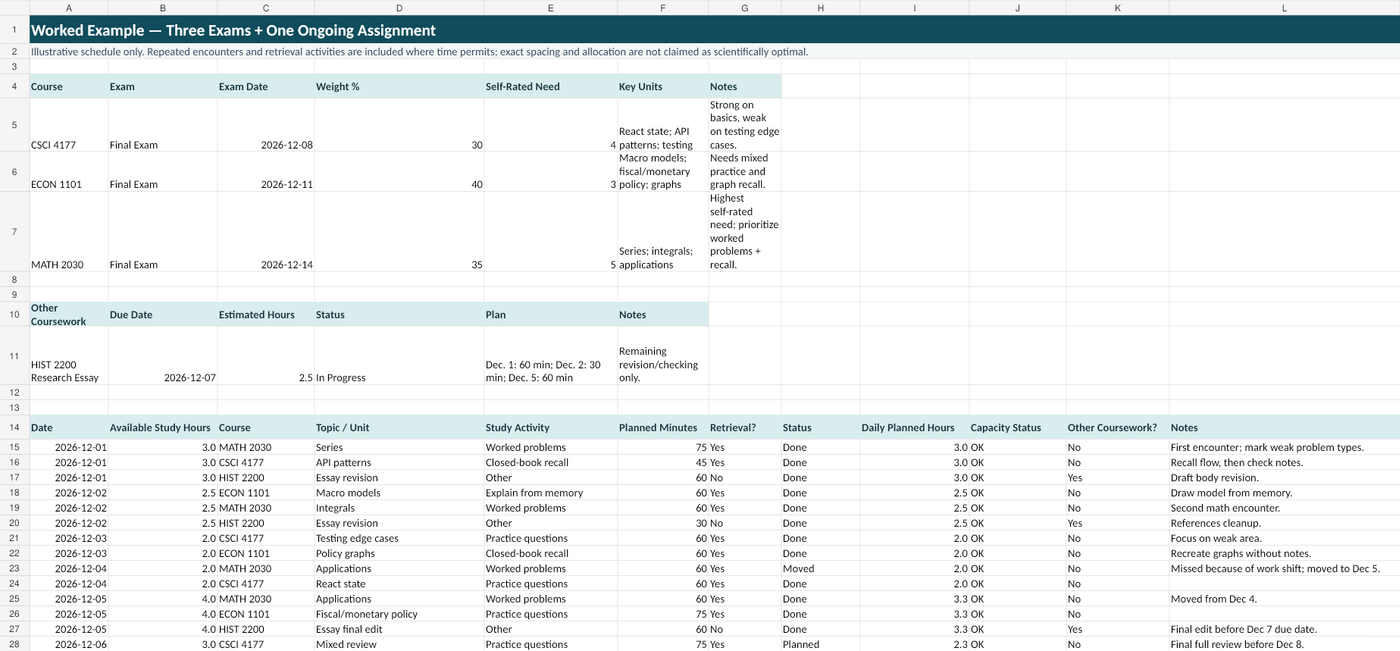
Worked example: three exams, one paper, limited time
Consider this schedule:
| Course | Exam date | Weight | Self-rated need |
|---|---|---|---|
| CSCI 4177 | Dec. 8 | 30% | 4/5 |
| ECON 1101 | Dec. 11 | 40% | 3/5 |
| MATH 2030 | Dec. 14 | 35% | 5/5 |
The student also has a HIST research essay due Dec. 7 with about 2.5 hours of revision and final checking remaining—not 2.5 hours to write the whole essay. The example reserves 60 minutes on Dec. 1, 30 on Dec. 2, and 60 on Dec. 5.
Dec. 1
Available: 3 hours
- MATH series — 75 minutes of worked problems
- CSCI API patterns — 45 minutes closed-book recall
- HIST essay — 60 minutes
Planned: 3 hours
Dec. 2
Available: 2.5 hours
- ECON macro models — 60 minutes explaining from memory
- MATH integrals — 60 minutes worked problems
- HIST references — 30 minutes
Planned: 2.5 hours
Dec. 3
Available: 2 hours
- CSCI testing edge cases — 60 minutes practice questions
- ECON policy graphs — 60 minutes closed-book reconstruction
Dec. 4: the plan breaks
Original plan:
- MATH applications — 60 minutes
- CSCI React state — 60 minutes
A work shift runs long, so the MATH session is missed.
Do not pretend it happened.
The adjustment is:
- keep the completed CSCI block;
- move the 60-minute MATH applications block to Dec. 5;
- keep the later Dec. 6 MATH recall block;
- check Dec. 5 capacity before adding the moved session.
The revised Dec. 5 plan is:
- MATH applications — 60 minutes
- ECON fiscal/monetary policy — 75 minutes
- HIST final edit — 60 minutes
Total: 3.25 hours inside a 4-hour availability window.
That is a feasible adjustment.
Step 7: As each exam approaches, change the type of work
The schedule should evolve.
Earlier sessions can identify gaps and build understanding.
Later sessions should increasingly test whether you can retrieve or use the material without the support you had earlier.
For example:
CSCI two days before the exam
- mixed practice questions;
- explain weak API patterns;
- check errors.
CSCI one day before
- shorter retrieval;
- no large new topic;
- verify the remaining weak points.
That is a practical planning choice, not a universal scientific rule.
What if you have only three days?
You cannot manufacture the benefits of time you no longer have.
A short-time plan should:
- list what is examinable;
- identify the highest-value gaps;
- preserve genuine retrieval;
- avoid spending all available time on passive review;
- keep the schedule inside actual available hours.
The research on spacing does not justify pretending that a compressed three-day plan is equivalent to a longer distributed plan.
It simply tells us not to waste the remaining time by massing every activity into one undifferentiated session.
What about interleaving?
Interleaving—mixing related categories or problem types—can help in some learning tasks, particularly where distinguishing similar categories matters.[8]
But the evidence is heterogeneous.
Do not turn “interleaving” into a rule that says every student must rotate between every subject every hour.
Use it contextually when mixing related problem types makes sense.
A complete final-exam planning checklist
Inputs
- ☐ Every exam date/time is entered.
- ☐ Major course topics are broken into study units.
- ☐ Other assignments and commitments remain visible.
- ☐ Real available study time is entered for each day.
Learning activities
- ☐ Study is distributed across several encounters where the calendar permits.
- ☐ Retrieval activities are included.
- ☐ Retrieval is followed by checking/correction.
- ☐ Passive review is not the only activity.
Feasibility
- ☐ No day is over capacity.
- ☐ Large assignments still have protected time.
- ☐ The plan does not rely on imaginary free hours.
- ☐ Missed sessions are explicitly moved, dropped, or reprioritized.
Evidence boundary
- ☐ No universal spacing interval is treated as proven.
- ☐ No fixed number of sessions is treated as optimal.
- ☐ The schedule does not promise grades, lower stress, or guaranteed exam performance.
- ☐ The exact allocation is understood as a planning framework.
For broader term-level planning before exam season, use How to Plan a College Semester That Can Survive Changes.
Download the editable schedule
Use the example as a model, then replace it with your own exam dates, topics, other deadlines, and real available time.
Sources
1. Cepeda, N. J., Pashler, H., Vul, E., Wixted, J. T., & Rohrer, D. (2006). Distributed practice in verbal recall tasks: A review and quantitative synthesis.
2. Cepeda, N. J., Vul, E., Rohrer, D., Wixted, J. T., & Pashler, H. (2008). Spacing Effects in Learning: A Temporal Ridgeline of Optimal Retention.
3. Rowland, C. A. (2014). The effect of testing versus restudy on retention: A meta-analytic review of the testing effect.
4. Adesope, O. O., Trevisan, D. A., & Sundararajan, N. (2017). Rethinking the Use of Tests: A Meta-Analysis of Practice Testing.
5. Agarwal, P. K., Nunes, L. D., & Blunt, J. R. (2021). Retrieval Practice Consistently Benefits Student Learning: A Systematic Review of Applied Research in Schools and Classrooms.
6. Cornell University Learning Strategies Center, Five-Day Study Plan.
7. Yan, V. X., Sana, F., & Carvalho, P. F. (2024). No Simple Solutions to Complex Problems: Cognitive Science Principles Can Guide but Not Prescribe Educational Decisions.
8. Brunmair, M., & Richter, T. (2019). Similarity matters: A meta-analysis of interleaved learning and its moderators.